

Maximizing Remaining Sight: Low Vision Rehabilitation
We empower individuals with permanent, irreversible vision loss to adapt, achieve independence, and improve their quality of life using customized assistive devices.
What is Low Vision?
A person with low vision is someone who has visual impairment even after medical treatment, surgery, or standard refractive correction (glasses or contacts), but who uses or is potentially capable of using their remaining vision to plan and perform daily tasks.
The World Health Organization (WHO) defines low vision as a best-corrected visual acuity of less than 6/18 down to 3/60, or a visual field loss of less than 20 degrees, in the better eye. It is a functional disability that cannot be fully corrected, but its impact can be minimized through rehabilitation.
Everyday Signs of Low Vision
Even when wearing standard prescription glasses or contacts, individuals may experience difficulty with:
- Recognizing the faces of friends and family members from a distance.
- Reading book print, labels, price tags, or writing letters.
- Navigating the neighborhood, crossing streets, or stepping over curbs safely.
- Performing close-up tasks like sewing, cooking, or matching clothes colors.
Common Causes of Low Vision
Low vision can result from various ophthalmological or neurological conditions. The most common underlying causes include:
Retinitis Pigmentosa (RP)
A progressive genetic disorder affecting the retina, causing night blindness and a gradual loss of side or peripheral vision (tunnel vision).
Macular Degeneration
Age-related macular degeneration (AMD) causes damage to the center of the retina (macula), blurring central vision while leaving side vision intact.
Diabetic Retinopathy
Damage to the blood vessels in the retina caused by diabetes, resulting in patchy, dark spots or generalized blurriness across the visual field.
Glaucoma & Lens Dislocation
Optic nerve damage from glaucoma leads to peripheral visual field loss. Lens displacement or congenital ocular anomalies also cause severe vision impairment.
Rehabilitation & Assistive Devices
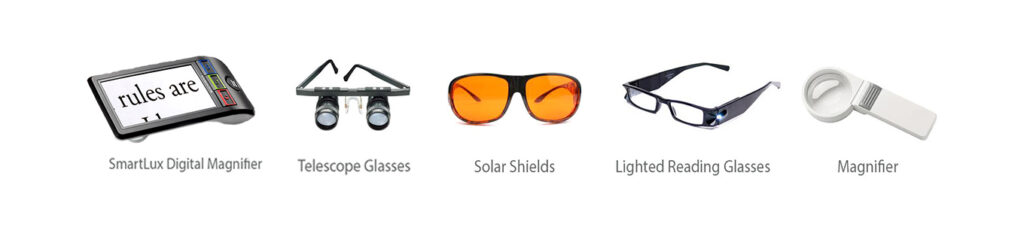
While low vision cannot be reversed, our specialized clinic trains patients to use assistive devices to maximize their functional visual capacity:
Optical Devices
Hand-held and stand magnifiers, high-power reading lenses, prism spectacles, loupes, and pocket telescopes.
Electronic Aids
Desktop video magnifiers (CCTVs), portable digital screen enlargers, and high-contrast digital devices.
Non-Optical Aids
Large-print texts, high-contrast signature guides, talking watches, and specialized adaptive home lighting.
Frequently Asked Questions
Can low vision be cured with surgery or medicine?+
No. Low vision is typically caused by permanent damage to the eye's visual pathway (such as the retina or optic nerve). Since this damage cannot be medically reversed or surgically replaced, low vision cannot be cured. Rehabilitation focuses on making the best use of the patient's remaining vision.
What is the difference between a normal eye exam and a low vision evaluation?+
A normal eye exam checks the health of your eyes and prescribes standard glasses. A low vision evaluation measures functional vision—testing how you perform daily activities, testing contrast sensitivity, light levels, and trying out specialized optical, digital, and adaptive devices to match your specific lifestyle goals.
How do I choose between electronic and optical magnifiers?+
Optical magnifiers (like hand-held or stand lenses) are portable, affordable, and excellent for short reading tasks like reading price tags or prescription bottle labels. Electronic magnifiers (such as CCTVs) are ideal for longer tasks like reading books, newspapers, or writing, as they offer adjustable contrast, color modes, and much higher magnification levels without distortion.
How can family members adapt the home environment for a low vision patient?+
Family members can improve lighting (especially task lighting for reading), minimize clutter to prevent falls, use high-contrast color choices (such as dark rugs on light floors, or writing with thick black markers on white paper), and label dials on appliances with bold markings.